7 Leg Press Variations for a Lower Body Workout
Fitness Tips
Feb 16, 2026 • 8min read
Squats get all the hype, but they aren’t always the right fit for everyone. If squatting feels awkward or uncomfortable, that doesn’t mean you have to skip leg day.
You can still crush leg day with the leg press, an ultimate workout that’s easily a close second to squats.
By performing leg press variations and exercises, you can tighten, tone and build all the major muscles of your lower body with just one machine. When done properly, leg press machine exercises can help build a strong, powerful lower body and improve overall leg definition.
Here’s everything you need to know about using the leg press to achieve a total lower body workout.
WHAT IS A LEG PRESS MACHINE?
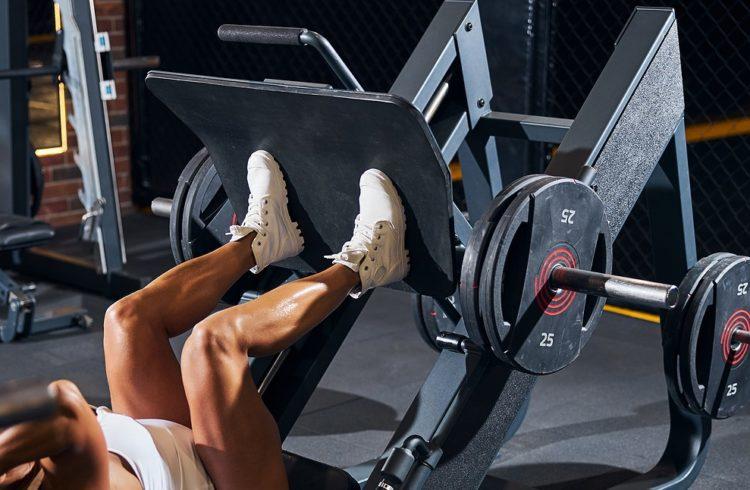
The leg press machine (also called a squat press machine) is one of the most common pieces of gym equipment for leg day. It features a seat and a foot platform that you push away from your body to activate your leg muscles.
Different gyms offer different types of leg press machines, so you’ll usually see one of two versions:
- The upright (weight-stack) leg press version is a seated machine that uses a built-in weight stack for resistance.
- A plate-loaded version is angled, requiring you to push the sled upward along a track.
Both give you the opportunity to do your leg press machine workout, just in slightly different ways.
New to leg press exercises? You can always take advantage of the EōS Personal Training programs for a personalized approach to learning proper technique and ensuring you are maintaining proper form.
Targeted Leg Press Muscles
It’s no secret that leg press exercises target the muscles in your lower body. Different leg press variations target some muscles more than others, but this machine works many of the major muscles in your lower body in general, including:
- Quadriceps
- Hamstrings
- Glutes
- Hip adductors
- Hip abductors
- Calf muscles
In addition to strengthening these muscle groups, leg press workouts help strengthen your knee and hip joints while placing less stress on the lower back than some free-weight movements. It’s also a great leg-day exercise option for beginners or anyone who needs to focus on proper form.
USING THE LEG PRESS MACHINE
No matter what type of leg press you use, the mechanics are similar. You place your feet on the platform and push it away from your body to mimic a squat pattern. Whether you’re doing basic leg press exercises or trying specific leg press variations, you can always get a full lower-body workout.
Need help getting started? Here are some tips on the best leg press form and technique:
- Keep your back flat against the machine’s pad throughout the exercise.
- Make sure both feet are fully on the platform.
- Start with low weight or no weight to warm up your muscles and get a feel for the machine.
- Inhale as you bring the platform down and exhale as you push out through your heels.
- Perform slow, steady and controlled reps. Don’t “bang out” reps by trying to press out as fast as possible.
- Control the descent of the platform. Don’t let it drop.
- Keep your knees slightly bent at the extension of each rep. Don’t lock your knees.
- When adding weight plates to the machine, always add the same amount of weight to both sides.
Once you get comfortable with different leg press foot placement variations, you can create a workout that trains your lower body in no time.
LEG PRESS VARIATIONS
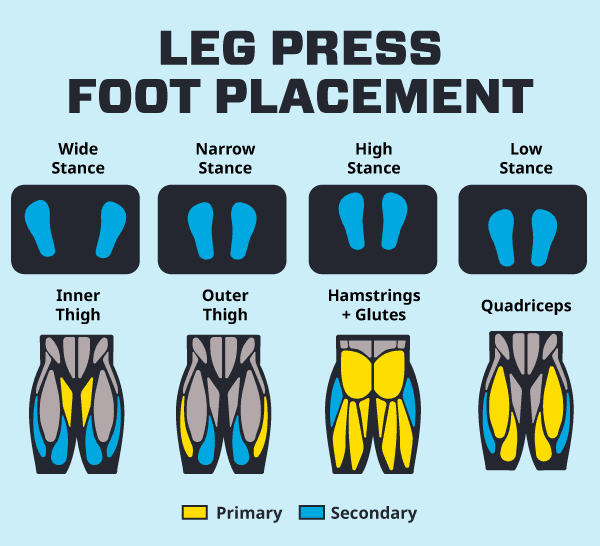
Over time, your body adapts to performing the same workout repeatedly, so you’ll get the most out of your leg press workout by incorporating different leg press variations.
Here are a few leg press exercises to get you started:
1. Standard Leg Press Stance
A great way to begin is to use the standard foot placement. Set your legs hip-width apart on the platform. This stance emphasizes overall leg development, focusing on glutes, hamstrings and quads.
2. Incline Leg Press
When you’re tired of the same old thing, it’s time to switch up your leg press positions and try it at an incline. An incline leg press is similar to a seated leg press, but the platform is tilted at 45 degrees. It’s a handy exercise to add to your routine because it not only targets the quads, hamstrings and glutes, but also uses the calves and adductors.
3. Wide-Stance Leg Press
For this alternative leg press exercise, scoot your feet to shoulder-width apart, or even a little wider, with your toes slightly turned out. This wider stance emphasizes your inner thigh muscles and hip adductors. Adductors help stabilize the hip joint and allow you to pull your legs together.
4. Narrow-Stance Leg Press
To balance the strength of your inner and outer thighs, you should work your abductors, the muscles on the outside of your quads. Your abductor muscles let you move your legs outward, like when you sidestep, and are essential to hip and core stability. Strong abductors may even help relieve back pain, along with hip and knee pain.
To work your abductors and outer quads, move your feet into a narrow stance. Your feet should be only slightly apart, with your toes facing outward or straight forward. This stance does require some stabilization, so you may want to hold onto the machine’s handles while exercising.
5. High-Stance Foot Placement Leg Press
Looking to sculpt your booty? Scooch your feet toward the top of the platform (rather than in the center). You’ll notice that this higher placement lets you better engage your hamstrings and glutes. The high-stance leg press is a good substitute for deadlifts, especially if you are experiencing back or hip pain.
6. Low-Stance Foot Placement Leg Press
Just as placing your feet higher on the leg press platform emphasizes your backside, lowering your feet toward the bottom of the platform will place more emphasis on your quads. A low-stance foot placement increases the range of motion of the knees, so if you experience knee pain, you might want to skip this variation.
7. Calf Work Variation
While a standard leg press workout can help tone your calves, this variation helps you build muscle mass. Your calves help you push off the ground and are important for running, jumping and sprinting.
To work your calves during leg press exercises:
- Move your feet to the very bottom of the leg press platform. Keeping the balls of your feet on the platform, let your heels hang off.
- Turn your toes slightly outward to work your inner calves and slightly inward to work your outer calves.
- Straighten your legs while keeping a slight bend in your knees so that they don’t lock.
- Use your calf muscles to press the platform up.
- Repeat for 10-15 reps.
The movement is slight, but after a few reps, you should begin to feel the burn in your calves. Keep the weight on the machine light at first, as your calves are not nearly as strong as the rest of your leg muscles.
8. Single-Leg Stance
Almost everyone has a dominant and non-dominant leg. In exercises that use both legs, the dominant leg may compensate for the less dominant one. Over time, this imbalance can affect form and increase your risk of injury or slow down your overall progress. To change it up and avoid these issues, try single-leg presses, where you work each leg separately.
Start with light weights and standard foot placement. Use the same weight and rep structures on both legs. You’ll likely notice that one leg is stronger than the other. Practice a single-leg press with each leg at the same weight until you build up equal strength in both legs.
THE BENEFITS OF USING A LEG PRESS MACHINE
(And Why It Might Be Better Than Squatting for Some)
Leg press workouts offer many benefits and can be a great alternative to squats. But what exactly are the benefits?
Well, the biggest reasons to incorporate leg press exercises into your routine are:
- You Can Easily Get a Full-Body Workout: Leg press machines let you perform compound movements that work all the major leg muscles. You can train some of the largest and most powerful muscles (like your calves) just by changing your foot position on the leg press.
- They’re Perfect for Beginners: Squats require mobility, balance and coordination, which can make them tricky for beginners. On the other hand, leg press machine variations are easy to learn while targeting the same muscles. Plus, the machine’s stability removes balance and coordination from the equation, so it’s better for introducing new gym-goers to the squat movement.
- A Leg Press is Great for Those with Mobility Challenges: If you have poor hip, knee and/or ankle flexibility, squats can be a struggle. Others with balance or mobility challenges may not be able to squat safely, so a leg press exercise is an ideal substitute. Leg press machine exercises also take a lot of pressure off the spine, making it a good option for those with back pain.
- They’re Customizable to your Top Fitness Goals: One of the best things about the leg press machine is that you can get out of it what you want, depending on your fitness goals. Those working to lose weight will appreciate that the machine targets the largest muscles of the body, resulting in a higher overall calorie burn. To tone lower-body muscles, use lighter weight and higher reps.
Performing leg press variations is also great for anyone looking to build serious muscle and achieve noticeable growth and definition.
INTEGRATING LEG PRESS VARIATIONS INTO YOUR WORKOUTS
Exploring different leg press variations will give you the best chance of muscle growth and a complete lower-body workout. At EōS Fitness, we have the leg press machines to help enhance your leg day workout. Sign up for a Free 7-Day Gym Pass today to get started.
Want to make the most of your leg press workout? Connect with a Personal Trainer at any EōS Fitness location for guidance or take advantage of our Free Welcome Workout.
LEG PRESS MACHINE VARIATIONS FAQs
What’s the difference between a leg press and a squat?
The main difference between a leg press and a squat is that squats require more balance and core engagement, while a leg press workout lets you focus on building leg strength while reducing stress on the lower back.
How many reps and sets should I do on the leg press?
Aim for 3–4 sets of 8–12 reps of leg press exercises for general strength and muscle growth. If you’re focusing on endurance, lighter weight with higher reps can be effective.
Is the leg press bad for your knees?
The leg press is generally safe for knees, as long as you use proper form and train within a comfortable weight range. You should also avoid locking your knees while pressing your lower back into the seat to reduce strain.